
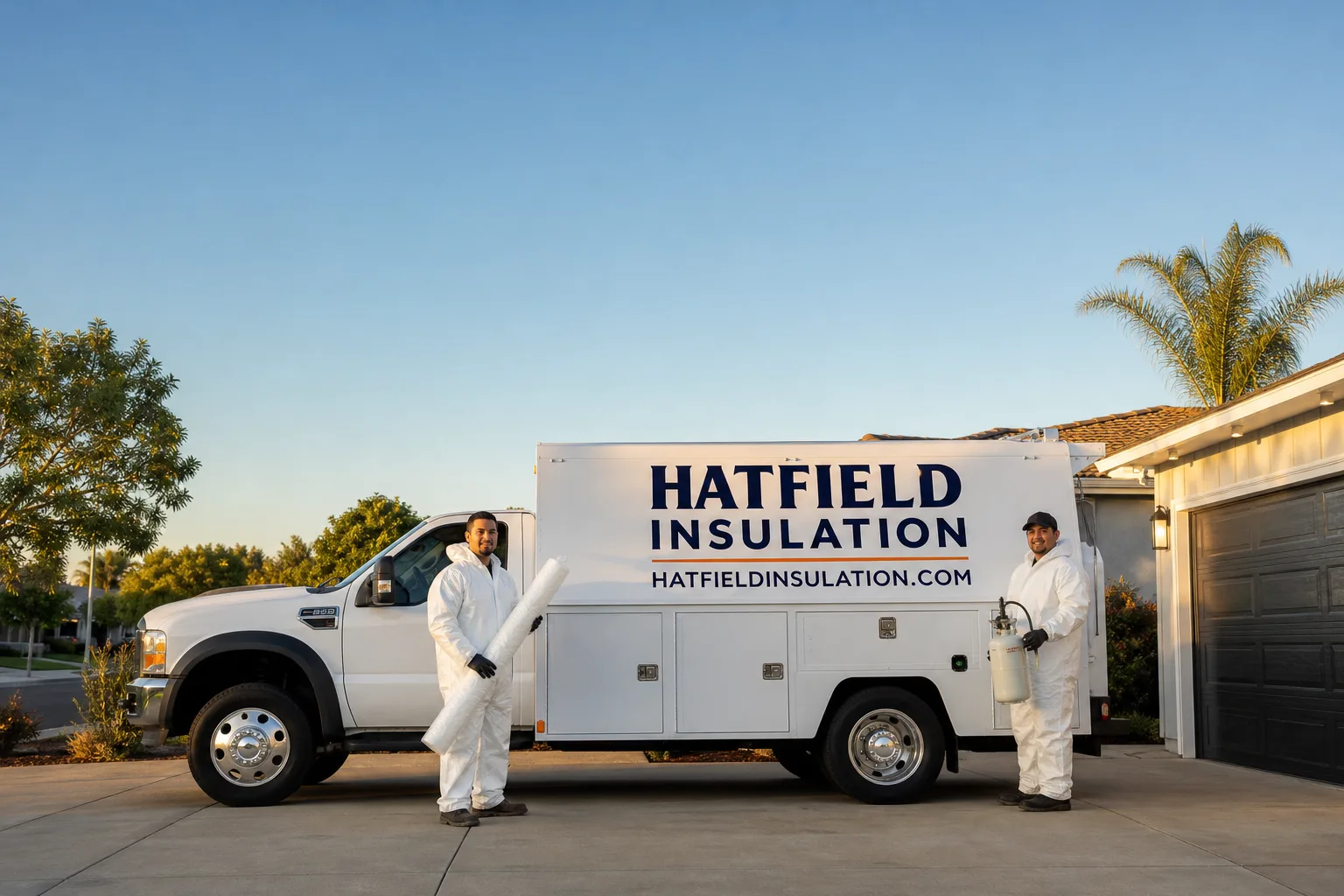
Fast, Reliable Spray Foam Insulation Across South San Jose Hills
Spray foam insulation in South San Jose Hills isn’t just about adding R-value. It’s about fixing what the sun does to a 150°F attic in August. Most homes here were built between the 1950s and 1970s, and nearly all of them have shallow, low-pitch attics where heat builds up fast and has nowhere to go. We’ve worked throughout the 91792 pocket long enough to know that every job starts with two questions: how hot is the roof deck getting, and can the attic actually breathe. If you’re dealing with rooms that won’t cool down or energy bills that climb every summer, call Hatfield Insulation at (866) 970-6477 and we’ll tell you what’s actually going on up there.
Why Hatfield Insulation Is South San Jose Hills’s Preferred Spray Foam Insulation Company
We’re insulation specialists, not a general contractor splitting time between plumbing calls and roofing jobs. That matters in South San Jose Hills because the homes here demand real diagnostics before any foam gets sprayed. Our crews know the shallow attic bays off the hillside streets, the original vent locations that were never adequate on 1950s ranch builds, and the west-facing slopes where deck temperatures climb past 150°F by early afternoon. When a South San Jose Hills homeowner calls, we don’t schedule a generic install. We send someone who understands how this specific housing stock behaves under Inland Empire heat.
Our Spray Foam Insulation team works across eight material brands including Icynene and Demilec for spray foam, plus Owens Corning and GreenFiber for other methods. That’s the point. We’re not married to one product, so the recommendation you get is based on what your attic actually needs, not what we happen to stock. For homes in South San Jose Hills with low-pitch roofs and blocked vents, that often means open-cell foam paired with air-sealing and venting corrections rather than just spraying closed-cell foam and walking away.
Homeowners in South San Jose Hills tell us the same thing after we finish: the upstairs finally cools down, the afternoon heat stops bleeding through the ceiling, and the AC doesn’t kick on every twenty minutes. That’s not luck. It’s what happens when you match the material to the house instead of forcing one product into every situation.
Crawl Space Spray Foam Insulation in South San Jose Hills
Crawl Space Spray Foam Insulation in South San Jose Hills solves a problem most people don’t realize they have until the floor feels cold in January or the house smells musty after rain. Many of the older ranch and tract homes in 91792 sit on ventilated crawl spaces that pull in damp air during winter rains and bake dry during summer. That moisture migrates up through the floor framing and makes the whole house harder to heat and cool. Sealing the crawl space rim joists with closed-cell spray foam cuts that air exchange off at the source. A typical crawl space rim joist job in South San Jose Hills runs $1,800 to $3,400 depending on linear footage and access.
Rim Joist Sealing
The rim joist is where the floor framing meets the foundation wall, and it’s the leakiest part of most crawl spaces. Closed-cell foam applied here stops outdoor air from entering and keeps conditioned air from escaping. On hillside homes near 91792 with exposed foundation walls, this is often the single highest-ROI insulation upgrade available.
Floor Deck Insulation
When a South San Jose Hills crawl space is fully vented and stays dry, we sometimes recommend open-cell spray foam applied directly to the floor deck. It quiets footfall noise and keeps the living space warmer in winter without trapping moisture against the subfloor. We never recommend this approach without confirming the crawl space actually dries out properly.
Garage Spray Foam Insulation in South San Jose Hills
Garage Spray Foam Insulation in South San Jose Hills gets overlooked constantly, and that’s a mistake. Most garages in 91792 are attached to the house, sharing at least one interior wall and often a ceiling with conditioned living space. When the garage ceiling is uninsulated, the garage becomes a solar oven every afternoon, and that heat radiates straight into the rooms above or behind it. Foaming the garage ceiling and the shared wall with open-cell spray foam typically costs between $1,200 and $2,800 in South San Jose Hills depending on square footage and whether we’re working around existing drywall.
Shared Wall Treatment
The wall between your garage and your living room is rarely insulated well, especially in 1960s and 1970s construction. Spray foam on this wall blocks garage fumes and heat from entering the home. It also helps with noise from garage door openers and workshop activity.
Garage Ceiling Air Sealing
If there’s a bedroom above the garage, this is the job that fixes it. We air-seal the ceiling plane first, then apply foam to stop heat transfer through the joist bays. Homeowners in South San Jose Hills report the room above the garage stops feeling like a sauna by mid-afternoon after this treatment.
Trusted Brands We Service in South San Jose Hills
We install Icynene and Demilec spray foam products for most 91792 jobs because both offer open-cell and closed-cell options that match this area’s specific heat and venting challenges. We also work with Owens Corning and GreenFiber for projects where spray foam isn’t the right call. Because we’re material-agnostic and stock across eight brands, we can typically start a South San Jose Hills job within days rather than waiting on a single supplier. Manufacturer warranties come standard on everything we install, so you’re not relying on our word alone.
Common Spray Foam Insulation Problems We See in South San Jose Hills Homes
- Blocked original roof vents. On 1950s and 1960s ranch homes, the original low-pitch roof vents were undersized to begin with, and decades of dust, paint, and pest debris have closed many of them off entirely. Foaming over a blocked vent system traps heat and moisture in the attic, defeating the purpose of the insulation.
- West-facing slope heat buildup. Homes on the west-facing hillside slopes in 91792 take direct afternoon sun on dark composite-shingle roofs, and deck temps regularly exceed 150°F. Without radiant control and correct venting, even the best spray foam can’t perform as rated.
- Shallow attic bays with thin foam. Hillside construction often leaves tight, shallow rafter bays that are easy to underfill or skip near the eaves. We see this constantly on retrofits done by crews without experience on this housing stock.
- Existing fiberglass that’s lost its R-value. Many South San Jose Hills homes still have the original fiberglass batts from construction. Under a hot roof deck, compressed and dusty batts lose a large share of their rated R-value, and homeowners wonder why their attic insulation “doesn’t work.”
Pricing for Spray Foam Insulation in South San Jose Hills, CA
Spray foam pricing in South San Jose Hills breaks down by area and foam type. Open-cell foam for a typical attic roof deck runs $2.00 to $3.50 per board foot installed, while closed-cell runs $3.25 to $5.00 per board foot. A full attic deck spray on a 1,200-square-foot ranch home in 91792 typically lands between $4,500 and $7,800 when paired with venting corrections. Garage ceilings run $1,200 to $2,800, and crawl space rim joist work runs $1,800 to $3,400. Every quote includes the venting and air-sealing assessment, because foam without those fixes is wasted money here. Call (866) 970-6477 for a free estimate with exact numbers for your roof.
We Also Serve Cities Near South San Jose Hills
Hatfield Insulation covers South San Jose Hills and the surrounding San Gabriel Valley communities. We work regularly in Rowland Heights, Hacienda Heights, La Habra Heights, and Brea. If you’re in any of these areas and want an insulation specialist who understands older valley housing stock, call (866) 970-6477 and we’ll schedule a look at your attic.
Serving South San Jose Hills, CA — Our Local Coverage Area
We’re based in the South San Jose Hills area and know this community well. Use the map below to see our service coverage — if you’re nearby, we can almost certainly help.
FAQs About Spray Foam Insulation in South San Jose Hills
Yes, but only when the venting is addressed first. Shallow low-pitch attics in 91792 trap heat and moisture, so we apply open-cell foam to the deck after clearing or adding vents so the roof can breathe. Closed-cell foam in an unvented shallow attic will bake the shingles from below. Call (866) 970-6477 for an attic assessment before you commit to a foam type.
Because the original vents are likely blocked or undersized, and the insulation you have is probably tired fiberglass that’s lost its R-value under 150°F deck heat. Air-sealing and venting corrections matter more than adding more material. We fix the airflow first, then insulate.
If your floors feel cold in winter or your garage-facing rooms bake all summer, yes. Crawl space rim joist sealing cuts moisture and air infiltration, and garage ceiling foam stops solar heat from bleeding into living space. Both are high-return upgrades on the older ranch homes common in South San Jose Hills.
No. Spray foam works alongside existing fiberglass as long as the air-sealing is done correctly. We can leave existing batts in place where they’re still performing and add foam where it counts. The materials don’t conflict, but the air-sealing details do matter.
Anything over 150°F by mid-afternoon means your roof deck is cooking and your insulation is underperforming. West-facing slopes in 91792 hit this routinely from June through September. That’s the signal to call (866) 970-6477 for a venting and insulation check before the next heat wave.
On a 1960s single-story ranch off the hillside streets near 91792, our crew opened a shallow, low-pitch attic and found the original roof vents fully blocked and deck temps reading past 150°F by early afternoon. We air-sealed the ceiling plane, applied Icynene spray foam to the deck in the constrained bays, and cleared and re-balanced the venting so the roof deck could actually breathe. The homeowner’s late-afternoon heat gain dropped noticeably within the first hot week.
Written by Nate Holloway, Owner at Hatfield Insulation, serving South San Jose Hills and the San Gabriel Valley.