
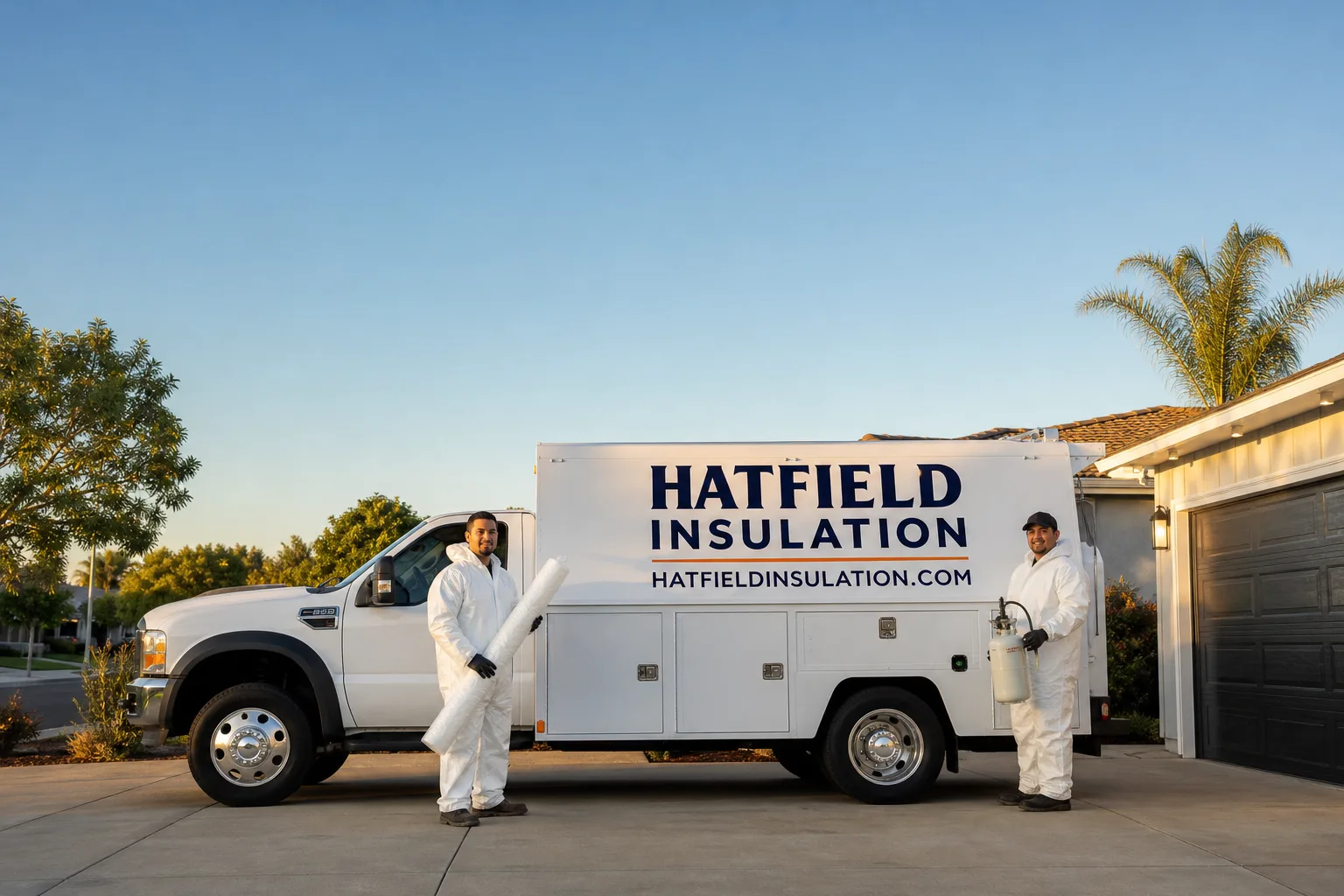
Fast, Reliable Spray Foam Insulation Across Hacienda Heights
Spray foam insulation in Hacienda Heights costs between $2.75 and $5.50 per square foot for open-cell and $3.75 to $7.00 for closed-cell, with most retrofit jobs running from $2,400 to $9,600 depending on access and square footage. Hatfield Insulation installs both open- and closed-cell spray foam across the 91745 zip code, and we stock products from Icynene and Demilec alongside fiberglass and mineral wool options so the recommendation fits the house rather than our inventory. If your Hacienda Heights home has a vaulted ceiling baking in summer heat or a rim joist leaking conditioned air, call (866) 970-6477 for a straight answer and a free estimate.
We work in Hacienda Heights every week. The hillside lots, the 1960s and 70s tract homes, the split-levels off Hacienda Boulevard with attics that hit 140°F in August – this is the terrain our crews know. Nate Holloway runs our insulation team, and he’ll be the first to tell you that a Hacienda Heights hillside retrofit is a different animal than a flat-lot job two miles east in Rowland Heights.
Why Hatfield Insulation Is Hacienda Heights’s Preferred Spray Foam Insulation Company
We’re an insulation specialist, not a general contractor that also happens to blow some foam. Every estimator and installer on our crew works insulation full time, which means when we open up a 1971 split-level above Hacienda Boulevard and find settled fiberglass at R-7 in a vaulted ceiling with no venting, we know exactly what that means and what to do about it. Homeowners in Hacienda Heights call us because they’ve heard from neighbors that we diagnose the ventilation problem before we spec the foam.
Nate Holloway built Hatfield Insulation around a simple position: eight brands, three installation methods, one trade. We carry Icynene and Demilec spray foam, plus Owens Corning, Rockwool, and GreenFiber products for jobs where spray foam isn’t the right call. When we recommend closed-cell foam for your rim joist, it’s because closed-cell is the correct material for that application – not because we’re locked into a single manufacturer. That material-agnostic approach matters in Hacienda Heights, where hillside homes present wildly different retrofit challenges from one street to the next.
Our response time to Hacienda Heights is typically same-day for estimates and within 48 hours for scheduled work. We keep our crews routed through the Puente Hills corridor regularly, so we’re not fitting you in from across the county.
Rim Joist Spray Foam in Hacienda Heights
Rim joist spray foam is the single highest-return air-sealing job we do in Hacienda Heights split-levels and ranch homes built between the 1950s and 1980s. The rim joist – that band of framing where your floor deck meets the foundation wall – is almost never insulated in original construction from that era, and on hillside homes with exposed foundation walls on the downhill side, it leaks conditioned air year-round. We spray closed-cell foam directly onto the rim joist to seal the gap, stop air movement, and add R-value in one pass. A typical rim joist spray foam job in Hacienda Heights runs $1,200 to $2,800, depending on linear footage and how much of the foundation is accessible from the crawl space or basement.
Why Rim Joists Fail in Hacienda Heights Construction
The 1960s and 70s tract builders in this area didn’t air-seal rim joists. It wasn’t code, and insulation was an afterthought. On sloped lots, the downhill foundation wall is often fully exposed above grade, so that rim joist band acts like an open vent pulling hot air in during summer and leaking heated air out in winter. In the Puente Hills, where summer cooling load dominates, that leak shows up as a warm floor along exterior walls and a second-story space that never quite cools down.
Closed-cell foam is the right material here because it air-seals and insulates in one application. Fiberglass batts stuffed into rim joist cavities don’t stop air movement – they just filter it. We see this constantly in Hacienda Heights: a homeowner paid someone to insulate their crawl space walls, but the rim joist was skipped, and the upstairs is still uncomfortable.
What the Install Actually Involves
We access the rim joist from the crawl space or basement, prep the surface so the foam adheres properly, and spray closed-cell foam to a minimum of 2 inches – though we typically go thicker on exposed downhill foundation walls where Hacienda Heights homes lose the most energy. Most jobs are done in a single day. The foam cures in seconds, and there’s no lingering odor beyond a few hours. You can be back in the house the same afternoon.
Crawl Space Spray Foam Insulation in Hacienda Heights
Crawl space spray foam insulation in Hacienda Heights addresses the under-floor cavity that older hillside homes almost never had properly sealed. Houses built on sloped lots off Colima Road and Hacienda Boulevard often have vented crawl spaces on the downhill side, which means outside air moves freely under the floor. In summer, that air is hot and dry; in winter, it’s cool and carries moisture up from the soil. Sealing and insulating that space with spray foam stabilizes floor temperatures and cuts the stack effect that pulls hot attic air down through the house. Crawl space spray foam in Hacienda Heights typically runs $1,800 to $4,200, depending on square footage, clearance height, and whether we’re insulating walls only or walls plus the rim joist band.
Hillside Crawl Spaces Have Unique Problems
The steeper your lot, the more exposed crawl space wall you have. On a flat-lot home in Whittier, the crawl space walls are mostly below grade, and the earth buffers the temperature. On a Hacienda Heights hillside, a three-foot-tall crawl space wall facing downhill is fully exposed to the afternoon sun, and that wall radiates heat up into your floor assembly all day long.
Spray foam is the right fit for these conditions because it conforms to the uneven, rocky, angled foundation walls common on Puente Hills lots. Batt insulation sags, falls off, and leaves gaps. Closed-cell foam bonds to the wall regardless of shape and adds structural rigidity that older foundation walls often benefit from.
Moisture and Venting in Hacienda Heights Crawl Spaces
Hacienda Heights gets about 14 inches of rain annually, and most of it arrives in a few winter storms. That means crawl spaces cycle through dry conditions most of the year, but during winter months the soil moisture rises. We always check the existing venting before recommending spray foam in a crawl space here. Some older hillside crawl spaces have too much venting, some have none, and the fix is different in each case. Nate Holloway’s crews are trained to evaluate the moisture profile before we spray anything.
Trusted Brands We Service in Hacienda Heights
Hatfield Insulation is not a one-brand shop. We install Icynene and Demilec spray foam products, and we also work with Owens Corning and GreenFiber when the job calls for fiberglass or cellulose instead. That matters in Hacienda Heights because no single product line handles every hillside retrofit situation. An unvented vaulted ceiling needs a different material strategy than a vented attic floor, and a brand that excels at one may be the wrong pick for the other. We keep material lead times short for Hacienda Heights customers because we’re routing through the San Gabriel Valley regularly, and manufacturer warranties apply on every brand we carry.
Common Spray Foam Insulation Problems We See in Hacienda Heights Homes
- Foam applied over unvented vaulted ceilings without addressing ventilation first. The 1960s – 70s hillside homes above Hacienda Boulevard often have vaulted ceilings with no attic space and no venting. Spraying foam directly onto the underside of the roof deck without adding ventilation or a radiant barrier traps heat in the assembly and can cause drywall blistering and moisture problems.
- Poor adhesion on dusty or oily 1950s – 80s framing. Old hillside attics collect decades of dust, and two-component spray foam won’t bond to a dirty substrate. We’ve opened up jobs in Hacienda Heights where another contractor sprayed over unprepared framing, and the foam peeled off in sheets within a year.
- Thin or missed coverage at rim joists and eave corners. Tight, angled framing where the roof meets the wall in 1960s – 70s split-levels is hard to reach, and a rushed install leaves thermal bridges that undermine the entire envelope. We see this consistently in Hacienda Heights homes where the original insulation was installed without air sealing.
- Insulation added without addressing the radiant heat load from the Puente Hills sun exposure. West- and south-facing hillside homes take direct afternoon sun, and adding R-value without a radiant barrier or attic ventilation produces diminishing returns. The upstairs still feels hot because the heat is radiative, not conductive.
The Hacienda Heights Vaulted Ceiling Problem
Here’s what makes Hacienda Heights different from the flat tract developments in neighboring cities. The 1960s and 70s hillside homes off the ridges above Hacienda Boulevard were often built with vaulted or cathedral ceilings added onto sloped lots where a full attic wasn’t part of the design. Those ceilings have no attic space, no ventilation channel, and minimal insulation – sometimes as little as R-7 of settled fiberglass. When the summer sun pounds those roof decks, temperatures in the ceiling cavity spike, and the living space below becomes an oven.
The mistake we see repeated in Hacienda Heights is treating this like a standard attic insulation job. Adding foam to an unvented vaulted ceiling without addressing ventilation and radiant control doesn’t fix the problem – it can make it worse by trapping heat and moisture in the assembly. The correct retrofit sequence is ventilation and radiant control first, then insulation. That’s the opposite of what most homeowners assume, and it’s the single biggest reason hillside homeowners in this community end up with disappointing results after paying someone to “add more insulation.”
Our Spray Foam Insulation team has seen this exact condition dozens of times across Hacienda Heights. We recently sprayed Icynene closed-cell foam along the rim joist and into the tight eave cavities of a 1972 split-level on the hillside above Hacienda Boulevard, where summer attic temps were spiking past 140°F. The original fiberglass had settled to R-7, and the vaulted ceiling had no venting, so we combined the foam with a radiant barrier and new eave vents. The homeowner reported a 12°F drop in upstairs room temperature the first week. That’s the sequence that works here: control the heat, then insulate the envelope.
Pricing for Spray Foam Insulation in Hacienda Heights, CA
Open-cell spray foam in Hacienda Heights runs $2.75 to $5.50 per square foot installed. Closed-cell runs $3.75 to $7.00 per square foot. A full attic roof deck retrofit in a 1,800-square-foot hillside home typically lands between $5,500 and $9,600. Rim joist work is smaller and tighter: $1,200 to $2,800 for most Hacienda Heights split-levels. Crawl space jobs run $1,800 to $4,200. What moves the number: access difficulty on sloped lots, how much old insulation needs removal first, and whether ventilation or radiant barrier work has to happen before we spray. Estimates are free, and our quote includes a breakdown so you see exactly what each step costs.
We Also Serve Cities Near Hacienda Heights
Hatfield Insulation serves Hacienda Heights and the surrounding communities, including Rowland Heights, East La Mirada, South San Jose Hills, and Whittier. If you’re in one of those areas and searching for Spray Foam Insulation in Hacienda Heights, we can help with the same level of local detail and attention to hillside-specific conditions. Call (866) 970-6477 to check our schedule for your street.
Serving Hacienda Heights, CA — Our Local Coverage Area
We’re based in the Hacienda Heights area and know this community well. Use the map below to see our service coverage — if you’re nearby, we can almost certainly help.
FAQs About Spray Foam Insulation in Hacienda Heights
Yes, spray foam can be used in vaulted ceilings, but only after ventilation and radiant control are addressed. Hacienda Heights hillside homes from the 1960s and 70s often have unvented vaulted ceilings, and spraying foam directly onto the roof deck without adding eave vents or a radiant barrier traps heat and moisture in the assembly. We evaluate each ceiling before recommending a foam approach, and in some cases we recommend against spraying the vaulted section entirely and instead focus on air sealing the rim joist and floor assembly. Call (866) 970-6477 and we’ll walk you through what’s actually happening in your ceiling cavity.
Spray foam is excellent for rim joists in Hacienda Heights split-levels because those homes were built without air sealing at the floor-to-foundation connection, and foam is the only material that both seals the air leak and insulates in one application. Closed-cell foam conforms to the angled, irregular framing common in hillside construction and won’t sag or fall out like batt insulation. On exposed downhill foundation walls, the rim joist band leaks enormous amounts of conditioned air, and closed-cell foam stops that completely. A typical Hacienda Heights rim joist job runs $1,200 to $2,800.
Yes. Hacienda Heights sits in a high fire-severity zone in the Puente Hills, and that influences material choices. Closed-cell spray foam has a class 1 fire rating and does not support flame spread the way open-cell foam can, so in homes near the wildland-urban interface we lean toward closed-cell products from Icynene and Demilec. We also recommend sealing gaps and penetrations that could allow embers into the structure during a Santa Ana wind event. Fire safety is one of the first conversations Nate Holloway has with hillside homeowners.
We evaluate the specific slope and drainage pattern first. Hacienda Heights crawl spaces on sloped lots are different from flat-lot crawl spaces because the downhill foundation wall is exposed and often uneven, rocky, or angled. Spray foam conforms to that surface where batts cannot. We check the existing venting and moisture profile before we recommend sealing the space, because some hillside crawl spaces have adequate natural drainage and some don’t. If the drainage is good, we spray the walls and rim joist and often convert the space to a conditioned or semi-conditioned state. Typical cost is $1,800 to $4,200 for most Hacienda Heights homes.
Adding R-value without addressing ventilation and radiant heat first. Hacienda Heights attics in 1950s – 80s homes were designed to vent, and the summer cooling load here is dominated by radiant heat from the sun. If you spray foam over an attic floor or into a vaulted ceiling without ensuring proper ventilation or adding a radiant barrier, you trap heat where it does the most damage. We see this all the time in hillside homes off Hacienda Boulevard: a homeowner paid for foam, but the upstairs is still hot because the heat was never controlled at the source. Before you spend money on foam, get a diagnostic look at your ventilation. We’ll do that for free at (866) 970-6477.
Call Hatfield Insulation for Spray Foam in Hacienda Heights
If your Hacienda Heights home fights you every summer – upstairs bedrooms that never cool down, floors that feel warm along exterior walls, energy bills that climb every August – the problem is probably in the envelope, not the HVAC system. We’ll inspect your attic, rim joists, and crawl space, then tell you honestly whether spray foam is the right fix or whether something else would serve you better. That’s the advantage of working with a company that carries eight brands across three installation methods: we’re not trying to sell you foam; we’re trying to fix your house. Call (866) 970-6477 today for a free estimate and a straight answer from Nate Holloway and the Hatfield Insulation crew.
Written by Nate Holloway, Owner at Hatfield Insulation, serving Hacienda Heights since day one.