Rockwool Attic Insulation in Fullerton: A Homeowner’s Guide
Rockwool attic insulation in Fullerton typically costs $2.10 to $3.40 per square foot installed, which runs roughly 30% to 60% more than fiberglass batts. The premium buys three things fiberglass can’t match: fire resistance rated above 1,400°F, dimensional stability that prevents edge gaps, and a density that measurably cuts outside noise. But it’s not the right product for every attic, and we’ll tell you exactly when it earns that price and when you’d be paying for performance you’ll never use. If you’d rather skip the research and get a straight answer for your specific attic, call (866) 970-6477 for a free estimate.
Key takeaways:
- Rockwool justifies its cost in Fullerton attics with can lights, older wiring, furnace equipment, or direct 91 freeway exposure
- It’s overkill for a simple attic with no heat sources and no noise problem where fiberglass batts perform nearly as well
- Installation precision matters more with Rockwool than fiberglass because its rigidity punishes sloppy cuts with thermal bridging
- Blown cellulose often outperforms Rockwool for Fullerton’s temperature swings at a lower installed cost
- Realistic ROI lands between 4 and 7 years depending on your current insulation depth and cooling habits
What Makes Rockwool Different From Fiberglass Batts
Rockwool, also called stone wool or mineral wool, starts as volcanic basalt rock melted at roughly 2,600°F and spun into dense fibers. Fiberglass starts as melted glass. That material difference shows up in three ways that matter in a Fullerton attic.
First, Rockwool doesn’t burn. It’s rated to withstand temperatures above 1,400°F without igniting or contributing fuel. Fiberglass itself doesn’t burn either, but its paper or foil facing does, and it melts at a much lower threshold. In a Fullerton attic that hits 150°F on a July afternoon near radiant sources like recessed can lights or older wiring, that temperature ceiling gives some homeowners genuine reason to pause.
Second, Rockwool holds its shape. Fiberglass batts sag over time, especially in cathedral sections or awkward joist bays. Rockwool’s semi-rigid form stays where you put it. That dimensional stability means fewer gaps opening up years after installation.
Third, and this is the one homeowners feel immediately, Rockwool is dense. Roughly three times denser than standard fiberglass. That density translates directly into sound absorption, which brings us to a uniquely Fullerton consideration.
When Fullerton Homeowners Should Pay the Rockwool Premium
We install Rockwool, fiberglass from Owens Corning and CertainTeed, and blown cellulose. We don’t push one material over another because no single brand or material wins every attic. Here are the three Fullerton attic scenarios where Rockwool genuinely earns its higher cost.
Scenario 1: Your attic contains heat sources. Recessed lighting, older knob-and-tube wiring, attic-mounted furnace units, or a water heater in the attic all generate heat or, in worst cases, ignition risk. Rockwool can sit directly against these surfaces without concern. Fiberglass requires careful clearance or protective boxes. If your Fullerton home was built before 1980, the wiring up there may predate modern safety codes, and the fire rating stops being a spec-sheet detail and starts being real protection.
Scenario 2: You live near the 91 freeway or the flight path. Fullerton Municipal Airport sees steady general aviation traffic, and homes off Euclid, Commonwealth, or Orangethorpe pick up freeway drone at all hours. Rockwool’s density gives it a noise reduction coefficient (NRC) that fiberglass simply can’t touch. In our experience, homes within half a mile of the 91 notice the difference within a week of installation. It won’t make the freeway disappear, but it rounds off the sharpest frequencies.
Scenario 3: Your attic has moisture exposure. Fullerton’s marine layer pushes morning humidity into unconditioned spaces through much of the spring and early summer. Rockwool is hydrophobic. Water beads off it rather than soaking in. Fiberglass, once wet, loses R-value and can host mold. If your roof has minor leaks, poor venting, or you’ve spotted condensation on sheathing, Rockwool’s moisture resistance is a functional advantage rather than a marketing claim.
When Rockwool Is Overkill for a Fullerton Attic
If your attic is straightforward: no heat sources, no noise complaint, a solid roof with working ventilation, and standard flat ceilings with accessible joist bays, then fiberglass batts installed correctly will deliver essentially the same R-value per inch at a meaningfully lower price. Rockwool’s advantages don’t disappear, but you’re paying for protections you don’t need.
The same holds for blown-in applications. Fullerton’s climate, with its hot dry summers and mild damp winters, actually rewards blown cellulose in many attic floors. Cellulose fills irregular joist bays completely, costs less than Rockwool batts, and its higher density blocks air movement better than semi-rigid batts in open attic floors. Where Rockwool wins is in wall cavities and sloped ceiling sections where a batt form factor holds itself in place.
The honest answer: if a contractor pitches Rockwool as universally superior for every Fullerton attic, they’re prioritizing margin over fit. Rockwool is a premium product with specific strengths. Like any material, it’s the right call in some attics and a wasted expense in others. That’s why we stock both, along with Johns Manville and Knauf fiberglass lines, and why our estimators are trained to recommend based on the attic conditions they actually see.
What Rockwool Installation Actually Looks Like
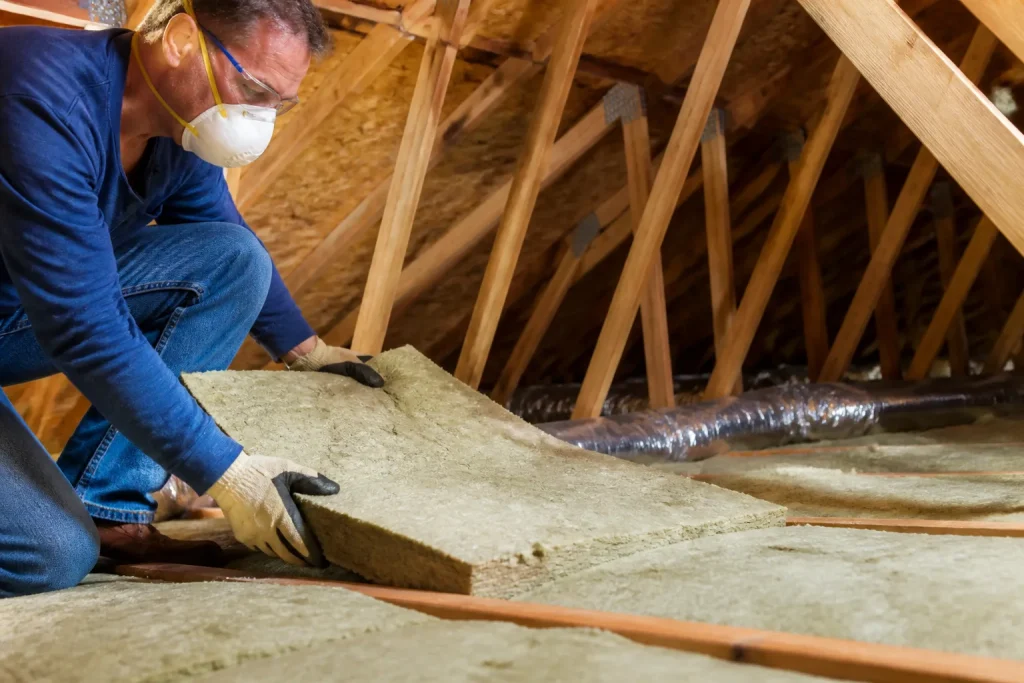
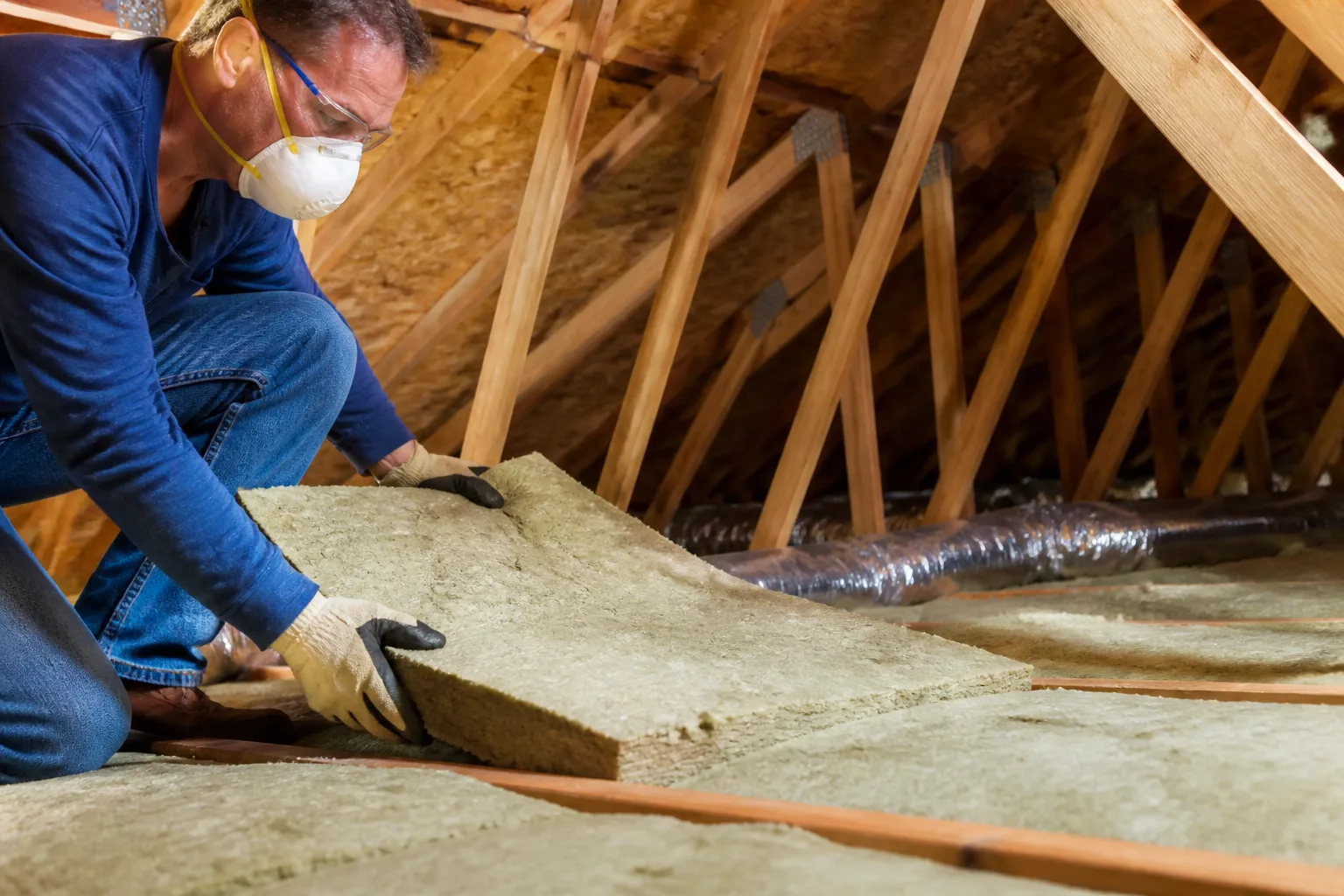
Rockwool installs differently than fiberglass, and the difference is where quality control lives or dies. Fiberglass batts compress slightly, forgiving a sloppy measurement. Rockwool is semi-rigid. If you cut it a quarter inch too wide, it crumbles at the edge. If you cut it a quarter inch too narrow, you’ve created a thermal bridge, a linear gap where heat moves around the insulation rather than stopping at it.
That precision requirement is why Rockwool installation quality varies so much between contractors. In Fullerton attics with irregular joist spacing, the installer has to measure and cut each batt individually. No two bays are guaranteed identical, especially in homes from the 1950s and 60s where framing was done largely by hand. A rushed crew using this material leaves edge gaps that erase the performance advantage within a year.
When to call a pro: Rockwool installation is absolutely a professional job. The material is dense and cuts with a specialized serrated blade. More importantly, attic work in a Fullerton summer means working in 140°F-plus conditions, and doing that safely while maintaining measurement discipline takes an experienced crew. If you’re considering Rockwool, get an installer who works with it regularly rather than one who stocks it occasionally.
Related services in Fullerton: If Rockwool isn’t the right fit for your attic floor, see our Blown In Insulation in Fullerton page for how cellulose compares. For sloped ceiling sections and rim joists where air sealing matters most, our Spray Foam Insulation in Fullerton service addresses what batts can’t reach. And our main Attic Insulation in Fullerton page covers the full range of attic-specific options.
Real Costs and ROI for Rockwool in Fullerton
Here’s what we’re seeing for installed pricing in Fullerton attics as of this year:
- Rockwool batts (R-15 to R-23): $2.10 to $3.40 per square foot installed
- Fiberglass batts (R-15 to R-38): $1.20 to $2.00 per square foot installed
- Blown cellulose (R-38 to R-49): $1.50 to $2.30 per square foot installed
For a standard 1,200-square-foot Fullerton attic, Rockwool runs roughly $2,500 to $4,100 installed, fiberglass $1,450 to $2,400, and cellulose $1,800 to $2,750. These are installed ranges including removal of old material where needed.
The ROI question hinges on two variables: what’s currently in your attic, and how hard your AC works during Fullerton’s July through September stretch. If you’re replacing R-11 fiberglass with minimal depth, going to R-38 with any material will cut cooling costs noticeably. Southern California Edison’s tiered rates mean heavy AC users in Fullerton pay premium per-kilowatt-hour pricing during peak summer months. Reducing attic heat transfer by 40% to 50% typically trims overall cooling load by 15% to 25%, which for a 2,000-square-foot home translates to $35 to $65 per month during peak cooling season. Over a 5 to 6 month cooling season, that’s $175 to $390 annually.
So for Rockwool specifically, you’re looking at a 4 to 7 year payback on the premium over fiberglass, assuming the house stays occupied and cooling habits don’t change. The payoff accelerates if you’re also solving a noise problem that improves daily life. It slows if your attic already has decent R-30 coverage and you’re chasing marginal gains.
Why Rockwool’s Fire Rating Matters More Than You’d Think in Fullerton
Every year, Southern California homeowners relearn the same lesson during Santa Ana wind season. Embers travel. Attic vents are the number one entry point for wind-driven embers in wildfires, and while Fullerton sits outside the highest-risk burn zones, the city isn’t immune to urban-adjacent fire risk in dry years. Rockwool’s non-combustible rating doesn’t make a home fireproof, but it removes the attic insulation as a fuel source and slows fire spread through the roof assembly. For homes near the Fullerton hills, Brea-adjacent neighborhoods, or any area with substantial tree canopy, that’s a real insurance consideration, not paranoia. Some insurers now ask about attic insulation type when underwriting in Southern California.
We pulled Rockwool out of an attic over in the Sunny Hills area last month where a homeowner had bought the house sight unseen. The previous owner had installed fiberglass directly against recessed lights, ignoring clearance requirements. The batts were discolored from heat exposure. Not a fire, but enough thermal stress to make everyone on the job stop and look. That’s the kind of thing that makes the Rockwool premium feel cheap.
The Bottom Line
Rockwool is the right choice for Fullerton attics with heat sources, noise exposure from the 91 or Fullerton Municipal Airport, or lingering moisture concerns. It’s the wrong economic choice for a simple attic floor where blown cellulose or fiberglass batts deliver equivalent thermal performance for less money. The material is only as good as the install precision behind it, so choose an installer who works with Rockwool regularly. And never trust a contractor who tells you one product wins every application. It doesn’t.
If you’re in Fullerton and need help deciding, Hatfield Insulation offers free estimates. We’ll look at your attic, tell you what we’d put in and why, with real numbers attached. Call (866) 970-6477 to schedule a visit.
Frequently Asked Questions
Rockwool is worth the extra cost if your attic has recessed lighting, older wiring, attic-mounted equipment, noise from the 91 freeway or Fullerton Municipal Airport, or moisture issues. For a simple attic floor with none of those conditions, blown cellulose or fiberglass delivers similar R-value for less money. Call (866) 970-6477 for a free attic assessment that tells you which one actually fits your home.
Rockwool batts in Fullerton run $2.10 to $3.40 per square foot installed, meaning a standard 1,200-square-foot attic costs between $2,500 and $4,100. The range depends on R-value target, access difficulty, and whether old insulation needs removal. Estimates are free, so call (866) 970-6477 for an exact number.
Yes. Rockwool’s density, roughly three times that of fiberglass, allows it to absorb sound frequencies that fiberglass passes through. Homes within half a mile of the 91 freeway or under Fullerton Municipal Airport flight paths notice the difference within a week. It reduces the noise. It doesn’t eliminate it.
Rockwool is non-combustible and rated to withstand temperatures above 1,400°F, which makes it a safer choice in attics with older wiring or recessed lighting that generate heat. Fiberglass doesn’t burn either, but its facings can, and it melts at much lower temperatures. If your Fullerton home predates 1980, the fire rating becomes a practical safety feature rather than a specification.
Rockwool can be installed year-round, though attic work in a Fullerton summer means crews working in 140°F-plus conditions. Professional installers manage this with early morning starts and hydration protocols. The material itself is unaffected by installation temperature, unlike spray foam, which has specific temperature windows.
Learn more about our approach at the Hatfield Insulation home page, or call (866) 970-6477 to talk through your attic with someone who installs all three insulation types and will tell you which one your home actually needs.
Written by the team at Hatfield Insulation, serving Fullerton since 2017.
Need Insulation Help?
Call Hatfield Insulation — licensed & insured, here with fast after-hours help in Fullerton.
(866) 970-6477